Publications and Working Papers
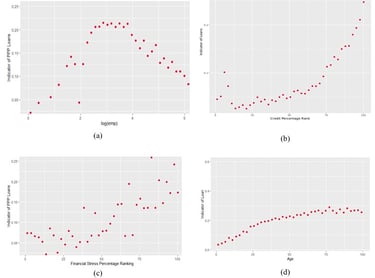
Legacy Lending Relationships and Credit Rationing: Evidence from the Paycheck Protection Program
Revise and Resubmit: Applied Economics
This paper examines how pre-existing lending relationships shaped access to PPP credit during the early pandemic. It shows how institutional frictions and relationship-based screening affected which firms received support, with implications for program design, credit allocation, and business resilience.
Keywords: Causal Impact · Credit Rationing · Policy Design · Small Business · Institutional Frictions
Structure, Risk, and Access to Credit: Reassessment of the Paycheck Protection Program Effectiveness
Revise and Resubmit: International Review of Economics and Finance
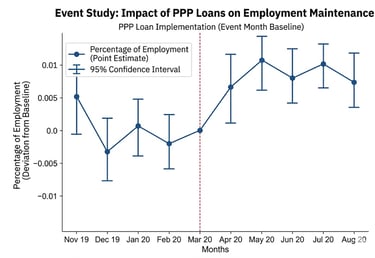
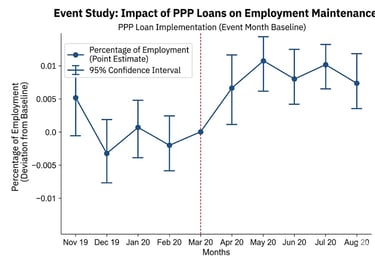
This paper reassesses the effectiveness of the Paycheck Protection Program by linking firm structure, risk characteristics, credit access, and post-program outcomes. It studies whether PPP support improved business survival and financial stability, while accounting for selection, firm heterogeneity, and pre-existing credit risk.
Keywords: Causal Impact · PSM-DID event study · Employment · Financial Stability · Heterogeneity Analysis
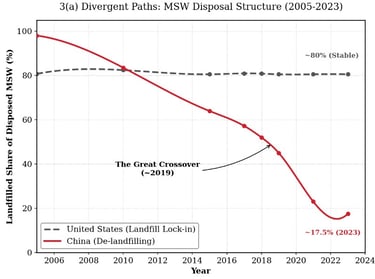
Modular Landfill Remediation for AI Grid Resilience
with Qi He, IEEE SYSCON 2026
This paper proposes a modular remediation strategy that links landfill methane reduction with AI-era grid resilience. It evaluates how landfill remediation, waste-to-energy conversion, and local energy infrastructure can support more resilient AI data center development while addressing environmental and land-use constraints.
Keywords: AI Grid Resilience · Landfill Remediation · Energy Systems · Sustainable AI · Infrastructure Policy
Waste-to-Energy-Coupled AI Data Centers: Cooling Efficiency and Grid Resilience
with Qi He, IEEE Green Tech 2026
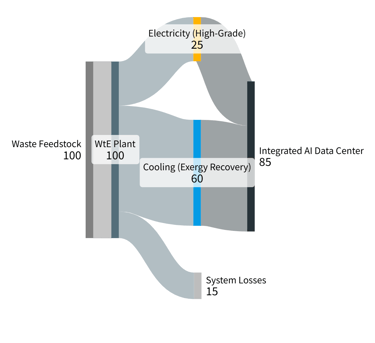
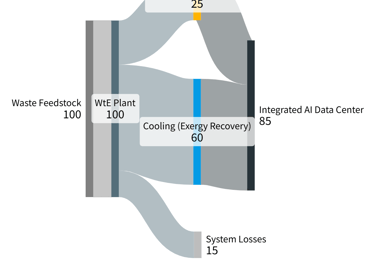
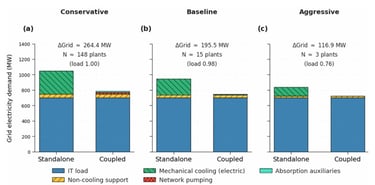
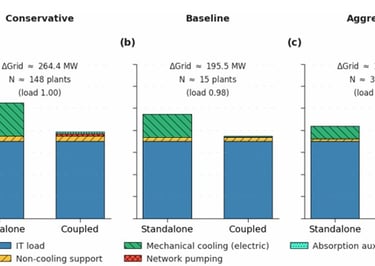
This paper introduces a waste-to-energy-coupled AI data center configuration that uses grade-matched heat for absorption cooling and grid relief. It develops a thermoeconomic screening framework to assess cooling coverage, auxiliary electricity use, heat-delivery losses, and cost viability.
Keywords: AI Data Centers · Waste-to-Energy · Thermoeconomics · Grid Resilience · Cooling Systems
Rare-Earth Exposure and Bottlenecks in AI Data Centers: Cost and Schedule Risk
with Qi He, Rui Shan, Yuan Tang, Yue Zou, Revise and Resubmit: RCR Advances
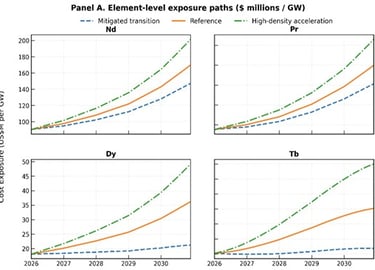
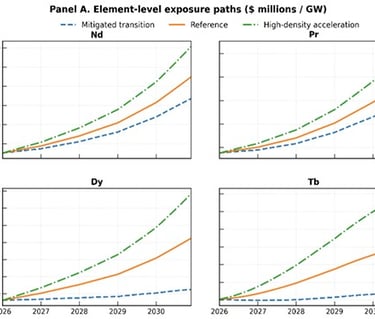
Build a transparent framework for measuring rare-earth exposure in AI data center development and estimating how supply-chain constraints can affect cost and deployment timelines. Decomposed infrastructure risk into component-level exposure, cost-share concentration, and schedule vulnerability.
Keywords: AI Supply Chain · Rare-Earth Exposure · Cost Risk · Schedule Risk · Infrastructure Scaling · Scenario Analysis
Planning Waste-to-Energy-Coupled AI Data Centers Through Grade-Matched Cooling and Corridor Screening
with Qi He, Wenjie Zuo, Thermo 2026, 6(2), 28
Developed a corridor-screening framework for evaluating whether waste-to-energy heat can support grade-matched cooling for AI data centers. Connected physical constraints, siting distance, cooling demand, parasitic load, and levelized cooling cost into an auditable decision framework for infrastructure planning.
Keywords: Waste-to-Energy · Absorption Cooling · Renewable Energy · AI Data Centers · Grid-Capacity Relief
AI Infrastructure & Decision Architecture
Causal AI, Credit Access & Policy Evaluation